

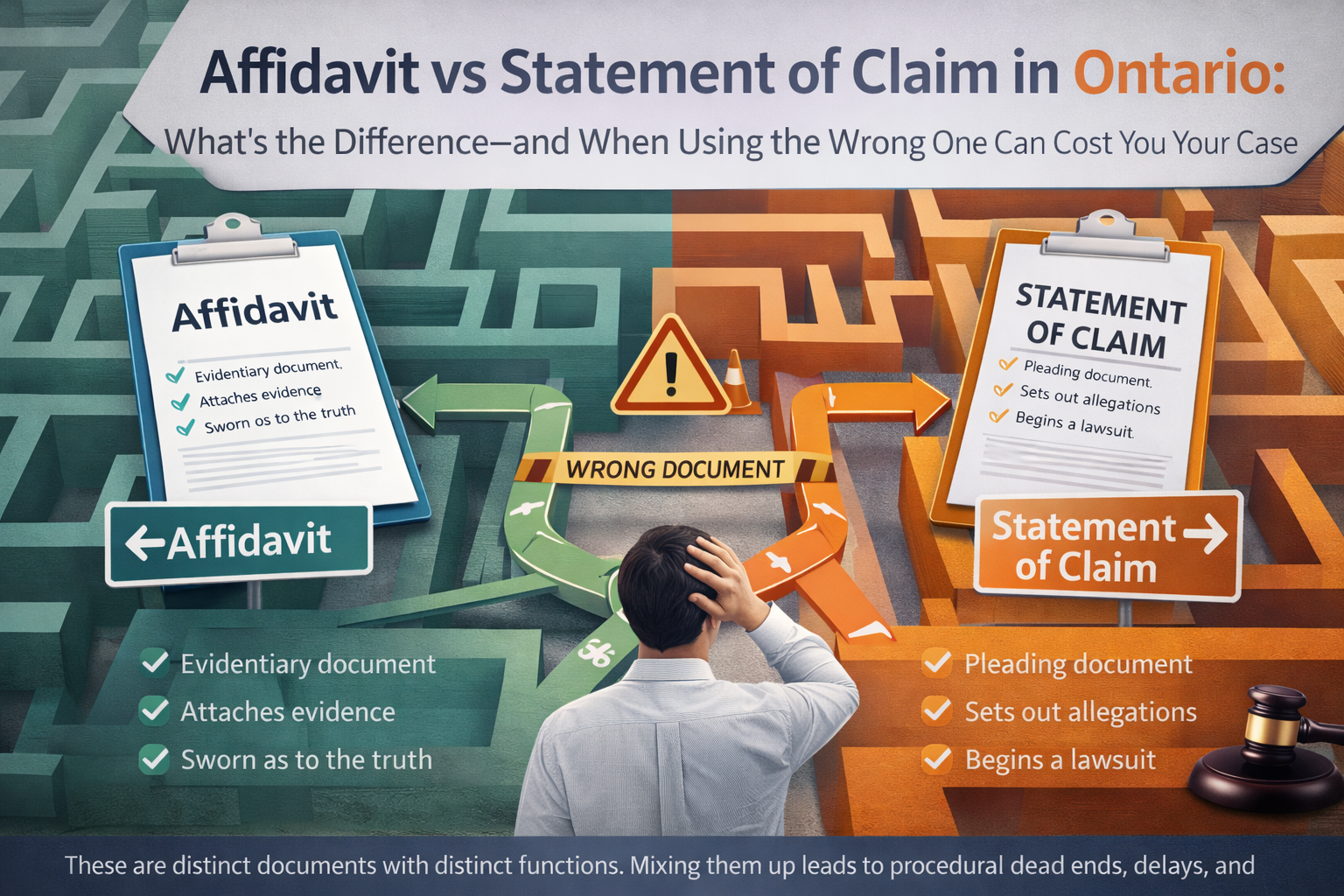
One of the most damaging procedural mistakes self-represented litigants make in Ontario is confusing affidavits with pleadings, particularly the Statement of Claim. At first glance, both appear to be formal court documents. Both involve facts. Both may be sworn or filed with the court. Yet they serve entirely different legal purposes—and using one in place of the other can derail a case before it ever reaches the merits.
Ontario courts do not excuse this confusion simply because a party is unrepresented. Each document plays a distinct role in civil litigation, and courts enforce those roles strictly. Understanding the difference between an affidavit and a Statement of Claim is therefore foundational to proper legal drafting in Ontario.
What a Statement of Claim Is—and What It Is Not
A Statement of Claim is the document that starts a civil action in Ontario. It defines the lawsuit. Its function is not to prove anything, but to clearly set out the material facts that establish the legal basis of the claim and the relief sought.
A proper Statement of Claim answers a narrow set of questions:
What happened? Who did what? When and where did it occur? What legal duties were breached? What remedies does the plaintiff seek?
Crucially, the Statement of Claim does not contain evidence. It does not attach exhibits. It does not argue credibility. It does not swear to the truth of facts. Its role is structural, not evidentiary.
A Statement of Claim typically includes:
- A concise statement of material facts
- Identification of the parties and their legal status
- The legal causes of action relied upon
- The relief sought from the court
When properly drafted, it allows the defendant to understand the case they must meet and allows the court to manage the litigation efficiently.
What an Affidavit Is—and Why It Is Different
An affidavit, by contrast, is an evidentiary document. It is a sworn statement of facts made under oath or affirmation. Affidavits are used to prove facts, usually in motions, applications, or interlocutory proceedings.
Unlike pleadings, affidavits may—and often must—attach exhibits. They may include documents, correspondence, photographs, medical records, or other materials relied upon as evidence. The affiant (the person swearing the affidavit) is testifying, in writing, to facts within their personal knowledge or belief (where permitted).
Affidavits are therefore governed by rules of evidence, not pleading rules.
Affidavits are commonly used:
- On motions (e.g., summary judgment, procedural motions)
- In applications
- To support interim relief
- Where oral testimony is not immediately available
They are not used to commence an action by way of Statement of Claim.
Why Confusing the Two Is a Serious Procedural Error
Ontario courts draw a sharp line between pleadings and evidence. When a litigant files an affidavit instead of a Statement of Claim—or drafts a Statement of Claim that reads like an affidavit—the court may find the pleading improper, embarrassing, or non-compliant with the Rules of Civil Procedure.
This mistake usually arises when litigants believe that “more detail” equals a stronger case. In reality, overloading pleadings with evidence often weakens them procedurally.
Courts take issue when pleadings:
- Are sworn or affirmed
- Attach exhibits or documentary evidence
- Argue credibility or motive
- Attempt to prove the case rather than define it
In serious cases, courts may strike the pleading, order it to be amended, or refuse to consider improperly filed materials altogether.
When Each Document Is Required—and When It Is Not
Understanding when to use each document is as important as understanding what it is.
A Statement of Claim is required:
- To commence a civil action
- To define causes of action
- To plead facts, not proof
- To seek relief from the court
An affidavit is required:
- To support or oppose a motion
- To present sworn evidence
- To introduce documents as exhibits
- To establish facts at an interim stage
Using an affidavit where a Statement of Claim is required—or vice versa—creates procedural confusion and exposes the case to early dismissal or delay.
A Common and Costly Scenario
Many self-represented litigants attempt to “strengthen” their case by filing an affidavit at the outset, believing the court needs proof immediately. The result is often the opposite. The court may refuse to accept the document, strike it from the record, or require the litigant to re-draft their materials—sometimes after deadlines have passed.
This confusion is particularly damaging where limitation periods, service timelines, or early motions are involved.
The Strategic Consequence of Getting This Wrong
When pleadings are defective, defendants gain a procedural advantage. They may bring motions to strike, delay the action, or force amendments that weaken the plaintiff’s position. Even where amendments are allowed, the litigant loses time, momentum, and credibility before the court.
This is why courts repeatedly emphasize that procedure matters. Proper sequencing of documents is not a technicality—it is part of substantive justice.
Final Thought
An affidavit and a Statement of Claim may both contain facts, but they exist for entirely different legal purposes. One proves facts; the other frames the dispute. Confusing them is one of the fastest ways to undermine an otherwise valid claim.
Legal drafting is not about volume—it is about function, structure, and timing.
If you’re unsure whether your document should be a pleading or an affidavit, don’t guess.
At MyCourtDraft, we help individuals and small businesses prepare court-ready documents that comply with Ontario procedure—before errors become expensive.
👉 Request a consultation today and ensure you’re using the right document at the right stage.