
Legal Framework: Contributory Negligence in Ontario
Contributory negligence is a partial defense in negligence cases, allowing a defendant to argue that the plaintiff’s own negligence contributed to the accident or injuries. In Ontario, the Negligence Act, RSO 1990, c. N.1 governs this principle. Under the Negligence Act, if the court finds that both the defendant and the plaintiff were at fault, it will apportion liability between the parties according to their respective degrees of fault. In other words, a plaintiff’s damages award is reduced in proportion to their share of responsibility for the loss. For example, if a plaintiff is found 25% at fault, they would receive only 75% of the full damages. Importantly, contributory negligence does not bar the claim entirely – the plaintiff can still recover compensation, but it will be diminished by their percentage of fault.
Ontario follows a comparative negligence approach, not an all-or-nothing rule. This means even if a plaintiff was partly negligent, they can recover the remaining portion of damages attributable to the defendant’s negligence. The onus is on the defendant to plead and prove contributory negligence; it is raised in the statement of defence as a specific allegation and must be backed by evidence. Vague or generic accusations won’t suffice – the defense needs to establish on a balance of probabilities that the plaintiff breached a duty of care and that this breach contributed to the accident or the plaintiff’s injuries. If a jury is hearing the case, the apportionment of fault between the parties will be left to the jury to decide. In a judge-alone trial, the judge will determine the percentages of fault or, if it’s impossible to determine, may default to a 50/50 split.
Denial of Liability and Plea of Contributory Negligence
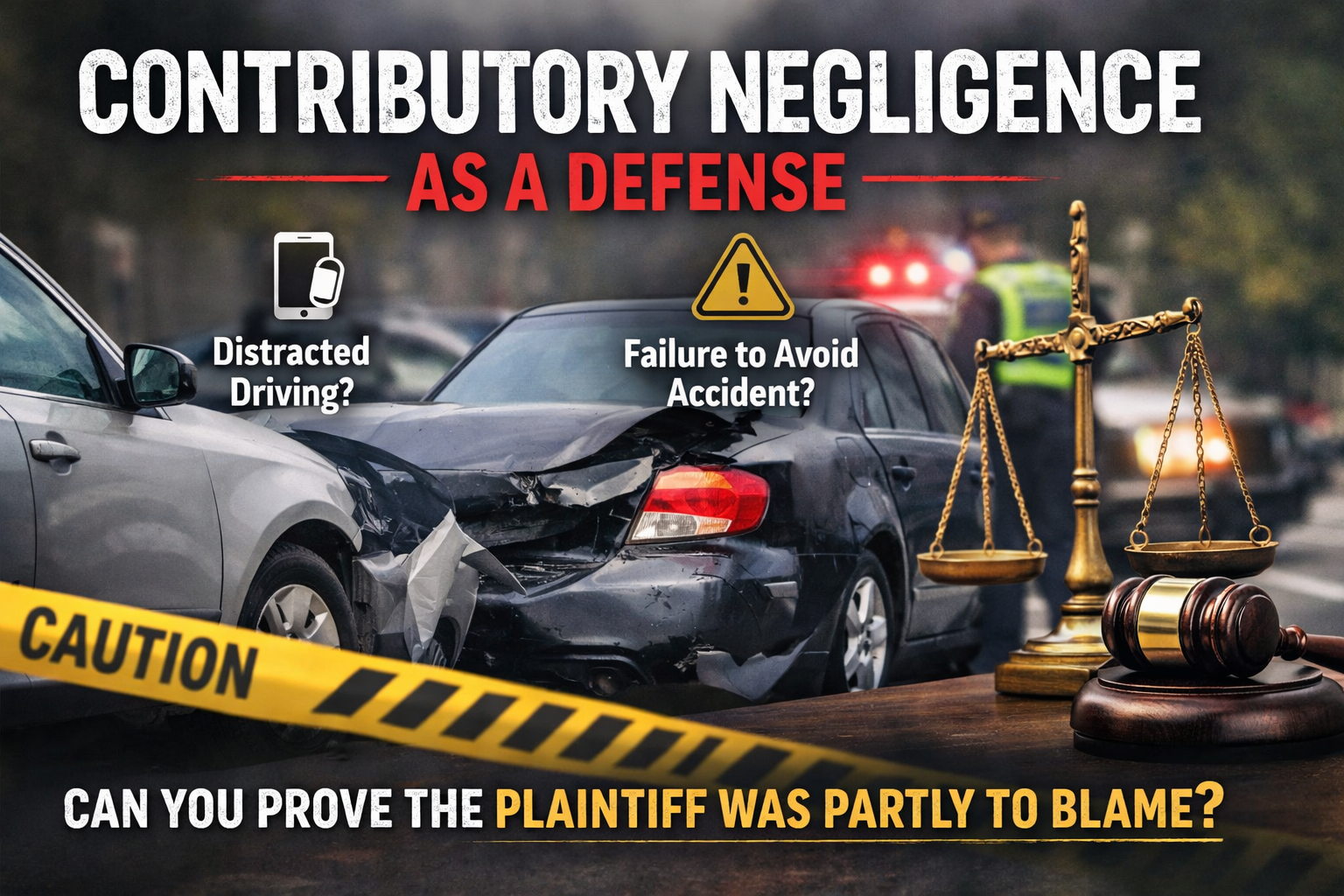
Defendants in negligence cases often deny liability by arguing that the plaintiff’s own negligence contributed to, or even wholly caused, the accident. In such a defense, the defendant will plead contributory negligence, alleging that the plaintiff failed to take reasonable care for their own safety. Common allegations include that the plaintiff:
- Operated their vehicle incompetently (e.g. lacking reasonable skill or care in driving);
- Was distracted by an electronic device (such as using a mobile phone or GPS while driving);
- Failed to avoid or mitigate the collision (did not take evasive action or brake in time when a hazard was observable); and
- Failed to warn of the impending collision (for instance, not honking the horn or alerting the other driver of danger).
In raising these allegations, a defendant in Ontario would invoke the Negligence Act, R.S.O. 1990, c. N.1, which provides for apportionment of liability in cases of shared fault. This means that if the court finds both parties were negligent, it can divide responsibility for the loss between them. The Act directs courts to determine the degree of fault of each party and apportion damages accordingly[1]. In other words, a successful contributory negligence defense can reduce or even eliminate the plaintiff’s recovery, depending on the plaintiff’s percentage of fault[2]. For example, if a plaintiff is found 25% at fault, they would receive only 75% of their total proven damages, reflecting their share of responsibility[3]. And if the defendant proves the plaintiff was wholly (100%) responsible for the accident, then the plaintiff would recover nothing.
When Can a Defendant Successfully Claim Contributory Negligence?
To successfully establish contributory negligence, the defendant bears the burden of proof to show that the plaintiff did not meet the standard of a reasonable person in looking out for their own safety[4]. There are a few key elements that a defendant must demonstrate for this defense to succeed:
- Plaintiff’s Lack of Reasonable Care: The defendant must prove the plaintiff “did not in his own interest take reasonable care of himself”[5]. This essentially means showing that the plaintiff acted (or failed to act) in a way that a reasonably prudent person would not have, thereby exposing themselves to foreseeable harm. The Supreme Court of Canada has affirmed that a person is contributorily negligent “if he ought reasonably to have foreseen that, if he did not act as a reasonable, prudent [person], he might be hurt himself”, and that in acting, one “must take into account the possibility of others being careless.”[6]. In practical terms, a plaintiff is expected to anticipate common hazards (including the potential negligence of other drivers) and take reasonable steps to avoid injury. Failing to do so can constitute a breach of their own duty of self-care.
- Causal Contribution to the Accident or Injury: It is not enough that the plaintiff was merely careless; their negligence must be causally connected to the harm they suffered[7]. The defendant must establish that the plaintiff’s act or omission contributed to the occurrence of the accident or the extent of the injuries. If the plaintiff’s conduct had no impact on the outcome (for instance, if the plaintiff’s negligence occurred but did not actually contribute to the collision or injuries), then contributory negligence will not be found[7]. Courts will scrutinize the facts to determine whether the plaintiff’s lack of care was a proximate cause of what happened. In Ontario, judges assess the plaintiff’s actions leading up to the incident, the nature of the event, and relevant precedents to decide if contributory negligence applies[8].
- Foreseeability of Harm: As part of the analysis, the harm must have been a foreseeable result of the plaintiff’s conduct. If a reasonable person in the plaintiff’s position would have foreseen the risk of injury and avoided it, then the plaintiff’s failure to do so may be deemed negligent[6]. For example, if a driver sees another vehicle backing up dangerously, it is foreseeable that a collision could occur, and a reasonable driver would sound the horn or try to get out of the way if possible. Not taking such precautions could be viewed as contributing to the collision. On the other hand, if the situation unfolded so quickly that the plaintiff had no reasonable opportunity to react, the plaintiff’s inaction would likely not be considered negligent – one cannot be faulted for failing to avoid an accident that was unavoidable in the moment. The law does not expect superhuman efforts, only reasonable ones under the circumstances.
- Specific Evidence of Plaintiff’s Fault: Successful contributory negligence defenses typically rely on specific facts showing what the plaintiff did wrong. Vague or generic allegations won’t persuade a court. The defense should point to concrete evidence – for instance, eyewitness testimony, surveillance footage, expert analysis of the accident – that illustrates the plaintiff’s missteps. Without such evidence, courts are hesitant to find a plaintiff at fault especially if the plaintiff’s role in the accident is minimal or unclear. In other words, merely asserting that the plaintiff “could have done something” is not enough; it must be proven that the plaintiff breached their standard of care in a way that contributed to the harm[7].
If these elements are established, the Negligence Act will govern the outcome by reducing the plaintiff’s damages in proportion to their share of fault[1]. Even when contributory negligence is proven, it does not nullify the claim entirely (unless the plaintiff is found entirely at fault); instead, it results in a partial defense, diminishing the defendant’s liability to pay. This apportionment approach reflects the law’s goal of fairness – each party should bear the portion of the loss that corresponds to their own negligence.
Examples of Contributory Negligence Scenarios
To better understand when a contributory negligence argument might succeed, it’s helpful to look at common scenarios recognized in case law and practice:
- Distracted Driving by the Plaintiff: If the plaintiff was driving while using a mobile phone or other device, the defense can argue the distraction contributed to the accident. Notably, even if the other driver’s negligence was the primary cause, a distracted plaintiff might be found partially responsible for failing to avoid or minimize the crash. For example, personal injury case studies in Ontario note that a driver who was looking at their cell phone when another vehicle crashed into them could be deemed a partial contributor to the accident[9]. The rationale is that, had the plaintiff been fully attentive, they might have honked, braked, or swerved to prevent the collision or reduce its severity. Key point: Using a phone behind the wheel breaches the driver’s duty to exercise reasonable care, and if it has a causal link to the outcome, it can result in a finding of contributory negligence.
- Failure to Keep a Proper Lookout or to React: All drivers have a responsibility to stay alert and observant of their surroundings. If the plaintiff noticed or should have noticed an imminent hazard and had the ability to evade it but failed to do so, a court may attribute some fault to the plaintiff. For instance, in one case a plaintiff’s vessel was struck by another boat, and the plaintiff was held 20% at fault for not keeping a proper lookout – leaving insufficient time to take measures to avoid the collision[10]. By analogy, a driver who fails to check their mirrors or pay attention to backup lights might similarly be found negligent if that failure contributed to a crash. Likewise, if a reasonable person would have sounded the horn or taken evasive action upon perceiving danger, the absence of any reaction could be viewed as a contributing factor. However, context matters: if the situation unfolded too quickly or the plaintiff had no safe options (e.g. no room to move or time to warn), then a failure to react may be excused as non-negligent. The standard is what a prudent person would do in the same situation.
- Not Using Safety Equipment (Seatbelts/Helmets): While not directly causing the accident, the plaintiff’s omission in using safety devices can contribute to the extent of injuries, which courts consider under contributory negligence. A classic example is the failure to wear a seatbelt. Ontario courts have routinely found plaintiffs partially responsible for their injuries when not buckled up, typically assigning somewhere around 5% to 25% of the fault for resulting injuries that could have been prevented or lessened by a seatbelt[11][12]. In fact, the Ontario Court of Appeal has capped seatbelt-related contributory negligence at 25% (recognizing that not wearing a seatbelt, while negligent, is seldom the sole cause of all injuries)[11]. Similarly, a motorcyclist or bicyclist not wearing a helmet could be deemed, say, 10–15% contributorily negligent for head injuries sustained in an accident[12]. These examples show that a plaintiff’s failure to take basic safety precautions can be a successful avenue for the defense – but the onus is on the defendant to prove that using the safety device would have made a difference (e.g. medical evidence that a seatbelt would have reduced the injury)[12].
- Plaintiff’s Violation of Traffic Rules or Incompetent Driving: If evidence shows the plaintiff violated traffic laws or was driving in a careless manner, a court may find contributory negligence if those actions contributed to the incident. Examples might include the plaintiff speeding, making an illegal turn, or stopping in a live lane without warning – any conduct that falls below the standard of a reasonable driver. As an illustration, if a driver abruptly brakes for no reason and is rear-ended, a portion of blame might be assigned to that driver for creating a sudden hazard. Likewise, a plaintiff who was not licensed or was knowingly driving a mechanically unsafe vehicle could be considered to have increased the risk of an accident. While each case is fact-specific, the underlying principle is that a plaintiff must also follow the rules of the road and exercise competence; a failure to do so can reduce their recovery if it plays a role in the accident.
- Knowing Acceptance of Risk: A specific type of contributory fault arises when the plaintiff knowingly puts themselves in a risky situation created by the defendant. A common scenario is riding with an impaired driver. If a plaintiff willingly rides as a passenger with a drunk or reckless driver, courts have found the plaintiff partly at fault for the ensuing injuries, since they ought to have foreseen the danger in that situation. For example, Ontario cases have held passengers 25-30% responsible for their injuries when they got into a vehicle with a driver they knew was intoxicated[13][14]. This overlaps with the idea of volenti non fit injuria (voluntary assumption of risk), but even short of a full volenti defense, it counts as contributory negligence that diminishes the plaintiff’s claim. The plaintiff in such cases failed to take reasonable care for their own safety by accepting a ride under unsafe conditions.
It’s important to note that courts will reject a contributory negligence argument if the plaintiff did everything a reasonable person could do in the circumstances. For instance, if a car is lawfully stopped at a red light (or in a queue) and is struck from behind with no warning, the stationary driver typically would not be found contributorily negligent – there was little they could have done to prevent a careless driver from crashing into them. In such clear-cut scenarios, the defendant’s attempt to blame the victim will not succeed. Successful contributory negligence defenses usually involve a more mixed fact pattern, where the plaintiff had some clear lapse or wrongful conduct that contributed to the harm.
Legal Impact of a Successful Contributory Negligence Claim
When a defendant does establish contributory negligence, the impact is governed by the Negligence Act’s apportionment rules. The judge (or jury) will assign a percentage of fault to the plaintiff and reduce the damages award accordingly[3]. For example, suppose a plaintiff’s total damages (for medical bills, lost income, pain and suffering, etc.) come to \$100,000. If the court finds the plaintiff 20% at fault and the defendant 80% at fault, the plaintiff’s award would be reduced by 20% – meaning they would recover \$80,000 instead of the full amount. Each side pays their share of the blame. This system ensures that the defendant is not over-penalized for harm that the plaintiff partly brought upon themselves, while still allowing an injured plaintiff to recover a portion of their losses even if they were negligent.
It’s also worth noting that raising contributory negligence is a very common defense strategy. Insurance companies and defense lawyers often plead contributory negligence as a matter of course, even if the evidence is marginal, because if they succeed in convincing the court of even a small percentage of plaintiff fault, it directly reduces the payout. The burden remains on the defense to prove it[15], and savvy plaintiffs’ counsel will challenge vague or unsubstantiated allegations. Courts require credible evidence of the plaintiff’s fault; speculation or hindsight arguments (“the plaintiff could have done X to avoid the crash”) will be closely scrutinized. Nonetheless, even a modest finding of contributory negligence (say 10%) can significantly affect the final judgment, so defendants have an incentive to raise the issue whenever plausible.
In summary, a defendant can successfully invoke contributory negligence when there is clear proof that the plaintiff didn’t act with reasonable care for their own safety and that this lapse contributed to the accident or the injuries suffered. Under those conditions, the law will apportion responsibility between the parties, potentially saving the defendant from a portion of the liability. All motorists and individuals are expected to take precautions for their own well-being – and failing to do so can come back to reduce one’s legal recovery in an accident claim[16].
[1] [2] [5] [6] [7] [10] [12] [13] [14] [16] Contributory Negligence and Joint and Several Liability – Dolden Wallace Folick LLPDolden Wallace Folick LLP
[3] A Guide to Contributory Negligence in Ontario
[4] [8] [11] [15] Contributory negligence: How Shared Fault Affects Compensation | Personal Injury Lawyers in Oakville
[9] Contributory Negligence in Ontario Injury Accidents
https://diamondlaw.ca/contributory-negligence-in-ontario-injury-accidents/