

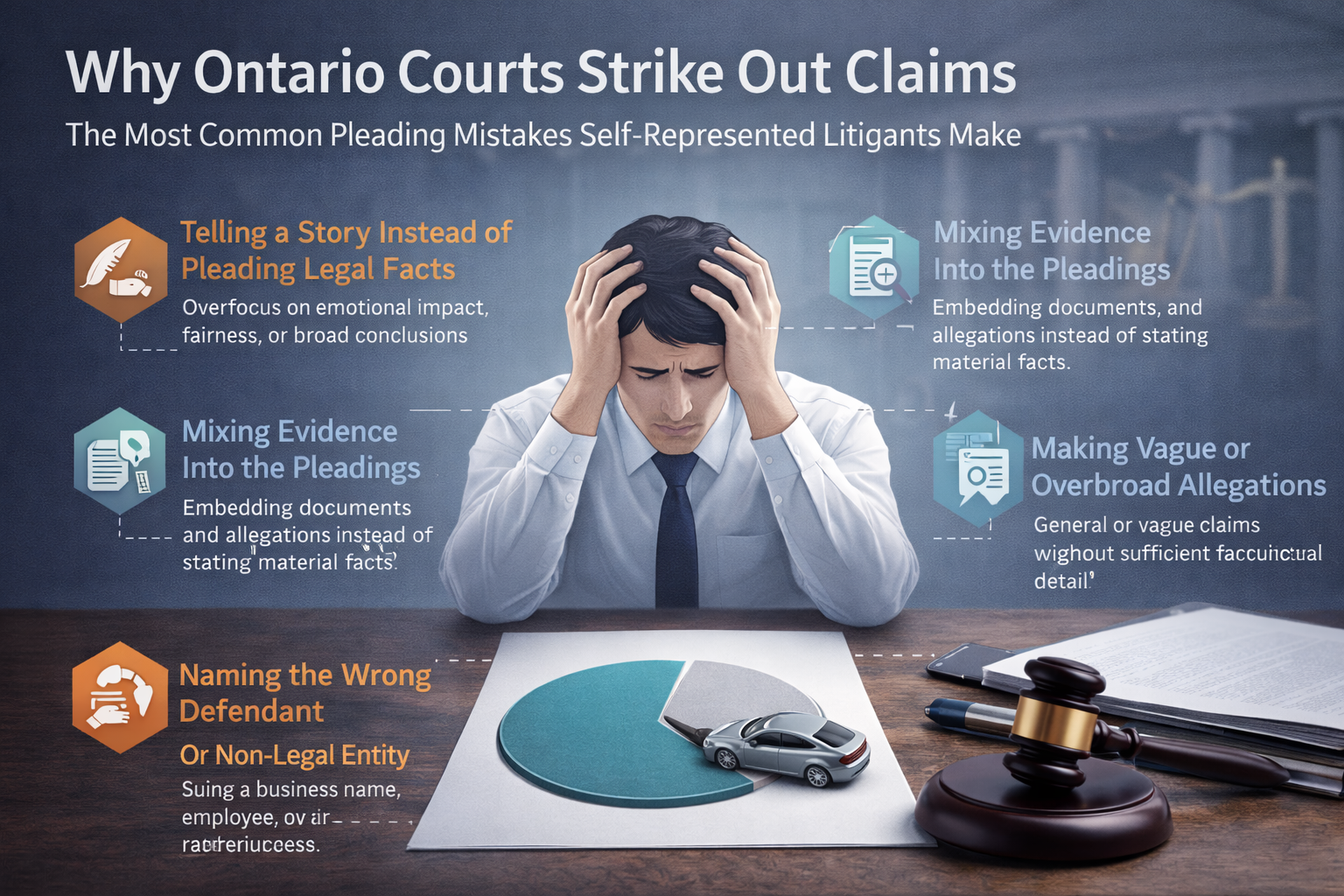
Ontario courts regularly strike out claims not because the underlying dispute lacks merit, but because the pleadings themselves are fundamentally defective. For self-represented litigants, this is often a painful surprise. The court never reaches the substance of the case; instead, the claim fails at the procedural gate. Understanding how courts assess pleadings—and where most litigants go wrong—is therefore critical for anyone drafting a Statement of Claim or Defence without full legal representation.
Pleadings are not informal narratives. They are structured legal documents governed by the Rules of Civil Procedure and decades of jurisprudence. Their purpose is narrow and technical: to set out the material facts that, if proven, establish a recognized cause of action or defence. When pleadings depart from that function, courts intervene early.
#1 Telling a Story Instead of Pleading Legal Facts
One of the most common errors made by self-represented litigants is treating pleadings as an opportunity to tell their story. While the emotional and personal context of a dispute may feel compelling, Ontario courts do not decide cases based on sympathy or fairness alone. They decide cases based on pleaded legal elements supported by admissible evidence.
A Statement of Claim must set out material facts, not opinions, emotions, or conclusions. Courts routinely strike pleadings that read like complaint letters, diaries, or moral arguments. Allegations such as “the defendant treated me unfairly,” “the conduct was shocking,” or “I suffered severe emotional distress” are legally meaningless unless anchored to recognized causes of action and factual particulars.
Common indicators of this mistake include pleadings that:
- Focus heavily on emotional impact rather than legal wrongdoing
- Use broad conclusions without supporting facts
- Argue the case instead of defining the issues
- Appeal to fairness or morality rather than legal duty
When pleadings are framed this way, courts often find that no reasonable cause of action is disclosed.
#2 Mixing Evidence Into the Pleadings
Another frequent and damaging mistake is embedding evidence directly into pleadings. Many litigants attach emails, screenshots, medical reports, text messages, or invoices to their Statement of Claim or quote them extensively within the document. While well-intentioned, this is procedurally improper.
Pleadings define what the case is about; evidence is introduced later to prove those facts. Ontario courts consistently reject pleadings that attempt to litigate the case at the pleading stage rather than set out a clean factual foundation.
This error typically appears where pleadings:
- Attach exhibits prematurely
- Quote correspondence verbatim
- Argue credibility or motive
- Refer extensively to future witnesses
Courts may strike or order such pleadings to be amended because they obscure, rather than clarify, the real issues in dispute.
#3 Making Vague or Overbroad Allegations
Vagueness is one of the fastest ways to weaken a claim. Statements such as “the defendant was negligent” or “the defendant breached the contract” may sound legally serious, but without factual detail, they are hollow. Courts require pleadings to answer the basic questions of who, what, when, where, and how.
A defendant must be able to understand the case they are required to meet. If they cannot reasonably respond because the allegations are unclear, the pleading becomes vulnerable to being struck or ordered to be amended.
Courts commonly take issue with pleadings that:
- Rely on general accusations without particulars
- Fail to link conduct to specific harm
- Combine multiple allegations into vague paragraphs
- Use legal labels without factual support
Precision is not optional in pleadings—it is essential.
#4 Naming the Wrong Defendant or a Non-Legal Entity
A surprising number of claims fail because the wrong party is sued. Business names, trade names, and informal descriptions are often mistaken for legal persons capable of being sued. Under Ontario law, only individuals and legal entities—such as corporations—can be defendants.
While courts may allow correction of a misnomer where the intended party is clear, suing the wrong party entirely can be fatal, particularly if limitation periods have expired. This mistake often arises from inadequate investigation before issuing the claim.
Typical examples include:
- Suing a business name instead of the registered corporation
- Naming an employee instead of the employer
- Confusing affiliated companies
- Assuming a brand name is a legal entity
This is a technical error with serious consequences and is often irreversible.
#5 Asking for Relief the Court Cannot Grant
Courts also strike or trim pleadings where the relief claimed is legally unavailable or unsupported by the pleaded facts. Relief is not aspirational; it must flow logically from the causes of action pleaded and be recognized by law.
Many self-represented litigants overreach, seeking remedies that courts simply do not grant in civil proceedings. When the relief sought bears no legal relationship to the facts pleaded, courts intervene.
Problematic relief claims often include:
- Punitive damages without egregious misconduct
- Injunctions without a legal basis
- Declarations unrelated to the dispute
- Duplicative or contradictory remedies
Relief must be precise, lawful, and grounded in the pleaded facts.
#6 Ignoring Limitation Periods and Procedural Requirements
Finally, even a well-drafted pleading can fail if it is filed too late, served improperly, or brought in the wrong court. Limitation periods and procedural timelines are strictly enforced. Courts do not relax these rules simply because a party is self-represented.
This issue commonly arises where litigants:
- File after the statutory limitation period
- Serve documents incorrectly or late
- Commence actions in the wrong court
- Fail to comply with mandatory procedural steps
Procedural compliance is not a technicality—it is a gateway requirement.
Why Courts Act Early on Defective Pleadings
Courts strike defective pleadings to protect the integrity of the litigation process. Pleadings define the scope of the case, the evidence that will matter, and the remedies available. Allowing vague or improper pleadings to stand wastes judicial resources and prejudices the opposing party.
This is why pleading defects are addressed early and decisively.
Final Thought
Most claims that are struck out fail not because the litigant was wrong—but because the case was never properly framed. Legal drafting is a discipline, not a formality. For self-represented litigants, this is often the most underestimated aspect of litigation.
If your Statement of Claim or Defence is already filed—or about to be—now is the time to get it reviewed.
At MyCourtDraft, we help individuals and small businesses prepare clear, compliant, court-ready pleadings that protect their legal position from the outset.
👉 Request a consultation today and strengthen your case before procedure defeats substance